What Your Website Actually Needs to Do (And What's Complete Bullshit)
I've got contractors in my network paying $700 a month for websites.
Cabinet makers. HVAC guys. Excavation crews. Windows and doors installers.
They're paying for "lead generation packages" and "SEO optimization" and "content management systems" and "monthly maintenance."
Most of it is complete bullshit.
What You're Actually Paying For
Let me break down what these $200-$700/month packages actually include:
Lead generation: Facebook ads that send people to your generic homepage. No specific landing page. No way to track which ad brought which customer. Just throwing money at Facebook and hoping.
SEO packages: Blog posts written by someone who's never met you about "10 Tips for Homeowners" or "How to Prepare Your Home for Winter." Generic content that ranks for nothing and helps nobody. Could be for any business in any city.
Content management systems: A fancy dashboard so you can update your website yourself. Which you never do. Because you're running a business, not writing blog posts.
Monthly maintenance: For what, exactly? It's a 5-page website. What needs maintaining? They're charging you $300/month to make sure your site doesn't break. It's not going to break.
Analytics dashboards: Tracking how many people visit your site. Not how many people call. Not how many turn into customers. Just visitors. That metric means nothing if your phone isn't ringing.
Complexity sold as necessity. Features sold as outcomes.
They're not selling you more customers. They're selling you more services.
What a Website ACTUALLY Needs to Do
Strip everything away. What's the real job of a contractor's website?
1. Show Up When Someone Searches for You
When someone types "HVAC repair Ottawa" or "excavation services Kanata" or your business name into Google, you need to appear.
That's local search. Google Maps. Your business name + your city.
You don't need 47 blog posts to make this happen. You need your services clearly listed, your location visible, and basic SEO setup. That's it.
2. Prove You're a Real Business
A professional-looking website tells customers you're legitimate.
Real photos of your work. Not stock images of models in hard hats. Real photos from real jobs.
Contact information that works. Phone number. Email. Service area.
That's the credibility check. That's what separates you from the guy working out of his trunk.
3. Answer the 5 Questions Every Customer Has
Every potential customer visiting your site wants to know:
-
What do you do? (Your services, clearly explained)
-
Where do you serve? (Your coverage area - cities, regions)
-
How do I contact you? (Phone number, contact form, hours)
-
Why should I trust you? (Photos of your work, years in business, certifications)
-
What does it cost? (If you're transparent about pricing, put it here)
Answer these five questions clearly and you've done the job.
Everything else is extra.
4. Make It Easy to Call You
Your phone number needs to be everywhere.
Top of every page. Big and clickable on mobile. Contact form that actually sends you the message.
Hours clearly posted so people know when to call.
That's it. Remove every barrier between "I need this service" and "I'm calling this company."
This is what your website needs to do. Everything else is noise.
Real Examples of What's Broken
I see this constantly in my network. Good businesses with terrible websites.
The Static Poster (Built Once, Forgotten)
Cabinet maker I know. Website from 2015. Never updated.
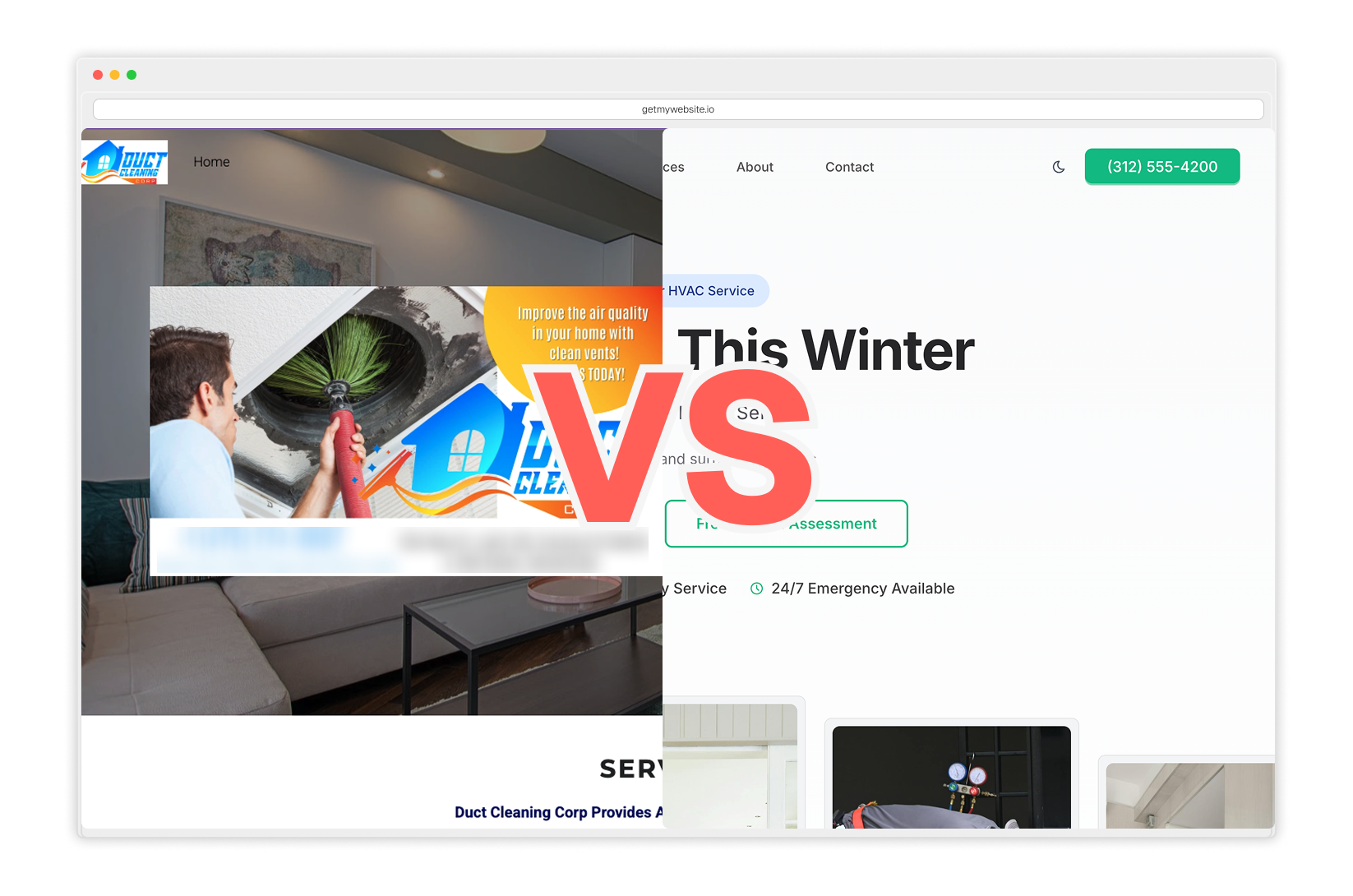
Hero section: "Welcome to our website." Generic background image. No clear explanation of what they actually build.
Services page: Vague descriptions. No photos of completed work.
Contact form: Sends to an email address the owner doesn't check anymore.
The site exists. That's it. It's not working for the business. It's just sitting there like a poster from 2005.
The Overbuilt Monster (Paying for Features They Don't Use)
HVAC company paying $500/month for a content management system.
When was the last time they logged in? "I don't know, maybe last year?"
Blog section with 3 posts from 2019. Resources page with PDFs nobody downloads. Fancy animations that make the site load slowly on mobile.
They're paying for features they don't need and don't use.
Why? Because the agency sold them a "comprehensive solution." Translation: stuff they can charge monthly for.
The Lead Gen Trap (Spending Without Tracking)
Excavation crew paying $700/month for Facebook ads and "lead generation."
Where do the ads go? Their homepage. Just the generic homepage.
Can they tell which ad brought which customer? No.
Can they prove the $700/month is bringing in more than $700 worth of business? No.
They're spending money because someone told them they should. But nobody's tracking if it actually works.
What Changed (And Why This Matters Now)
Here's what used to be true:
Building a professional website required:
- A dev team or expensive freelancer
- $5,000 to $15,000 upfront
- 2-3 months timeline
- $200-$500/month ongoing maintenance
So contractors had two choices:
- Pay a fortune for something custom
- Use a cheap platform builder and pay monthly forever
Both options sucked.
Here's what's true now:
AI didn't just make this faster. It made it accessible.
What used to require a dev team now requires someone who knows what they're doing plus AI plus 48 hours of work.
The barrier wasn't real skill. It was time and knowledge of how the pieces fit together.
That barrier is gone.
What You Actually Need (The Real Answer)
The Stack
A professional template built for your industry. HVAC template for HVAC companies. Plumbing template for plumbers. Windows and doors template for window installers.
Start with something built for your business. Customize it with your actual content.
Your real content:
- Services you offer (specific, not vague)
- Coverage area (cities and regions you serve)
- Contact information (phone, email, hours)
- Photos of your actual work
- Any certifications or credentials that matter
Mobile-responsive design. Most people finding you are on their phones. If your site doesn't work on mobile, you're losing half your potential customers.
Fast load times. Slow sites lose customers. Nobody waits 10 seconds for your homepage to load.
Clear call to action. Make it obvious how to contact you. Big phone number. Simple contact form. Remove every barrier.
That's what you need. That's the whole list.
What You DON'T Need
A content management system. Unless you're actually going to blog regularly (you're not), you don't need a CMS. You need a website that works.
Monthly maintenance contracts. For what? A 5-page site doesn't need monthly maintenance. If something breaks (rare), pay someone hourly to fix it.
Lead gen packages. Unless you can track actual ROI - calls that turn into jobs - you're just spending money. If they can't show you the numbers, don't pay for it.
SEO content mills. Generic blog posts written by someone who doesn't know your business don't help. They don't rank. They don't bring customers. They're filler to justify monthly charges.
Platform lock-in. If you're paying Wix or Squarespace or GoDaddy $500/month and you don't own your site and can't move it - that's not an asset. That's a subscription you can't escape.
The Real Talk on Costs
Here's what it actually costs to do this right:
One-time build: $249 for a template-based site. Up to $500 if you need customization.
Domain name: $12/year.
Hosting: Free on platforms like Vercel (for sites like this).
Updates: Do them yourself when needed (change your hours, add a new service). Or pay someone hourly when you want changes. $50-$100 per update, not $500/month forever.
Total Year 1: Around $500.
Compare that to $200-$700/month:
- $200/month = $2,400/year
- $500/month = $6,000/year
- $700/month = $8,400/year
You could pay for a professional website and own it outright for less than 3 months of what you're currently paying.
And you're not locked in. You're not paying forever. You own it.
Real Example: Ben's Hauling
I built a website for a local hauling company.
What they needed: Show what they haul. Show their coverage area. Make it easy to get a quote.
What they didn't need: A blog. Monthly maintenance. Lead gen packages. Analytics dashboards.
What we built:
- Clean homepage explaining their services
- Coverage area map (clear service zones)
- Simple quote request form
- Gallery of trucks and jobs
- Phone number everywhere
Time to build: 48 hours of work.
Cost: One-time payment.
Result: Professional web presence. Phone ringing. No monthly subscription.
That's what it looks like when you focus on what actually matters.
The Clarity You Need
Most contractors don't need what the industry is selling them.
You need a website that makes your phone ring.
You need a website that proves you're a real business.
You need a website that answers customer questions.
You need a website that works on mobile.
That's it.
The rest is noise. Noise designed to justify monthly subscriptions and recurring charges.
If you're paying $200+ a month for a website and you can't explain exactly what you're getting - you're getting ripped off.
If you don't have a website because you think it's too complex or too expensive - it's not. Not anymore.
The industry made this complicated because complexity sells. Ongoing services. Monthly retainers. Bundled packages.
But the actual problem is simple: You need customers to find you, trust you, and call you.
Everything else is bullshit.
What to Do Next
If you're paying monthly for website services:
-
Ask what you're actually getting for that money
-
Ask if you can track ROI (calls, customers, revenue)
-
Ask if you own your website or if you're renting it
If the answers are vague or you don't own your site - you're in the wrong deal.
If you don't have a website:
-
Get clear on what you actually need (not what agencies say you need)
-
Find someone who builds straightforward sites for contractors
-
Own it outright, don't rent it
Your website should be an asset. Not a monthly expense you can't escape.
About Get My Website: We build professional websites for contractors in 48 hours. HVAC, plumbing, excavation, windows, doors, cabinets - if you're a home services business, we've got you. $249 one-time. No monthly fees. You own it. GetMyWebsite.io

GetMyWebsite Team
November 14, 2025